
The snow rope
Foundation
The GlaciersAlive Foundation supported the Innosuisse project.
2020
First snow rope trials at the Diavolezza valley station.
From 2020 to 2023,
the snow ropes at the Diavolezza valley station were tested.
The snow rope
Foundation
The GlaciersAlive Foundation supported the Innosuisse project.
2020
First snow rope trials at the Diavolezza valley station.
From 2020 to 2023,
the snow ropes at the Diavolezza valley station were tested.
The snow rope – a ground-independent snowmaking system
Snow is an excellent form of glacier protection. The production of artificial snow using conventional snow machines (snow cannons/lances) is particularly widespread in ski regions, but requires stable ground conditions. As part of an Innosuisse project, a ground-independent snowmaking system has now been developed for the first time, primarily for glacier protection to secure frozen freshwater reserves.
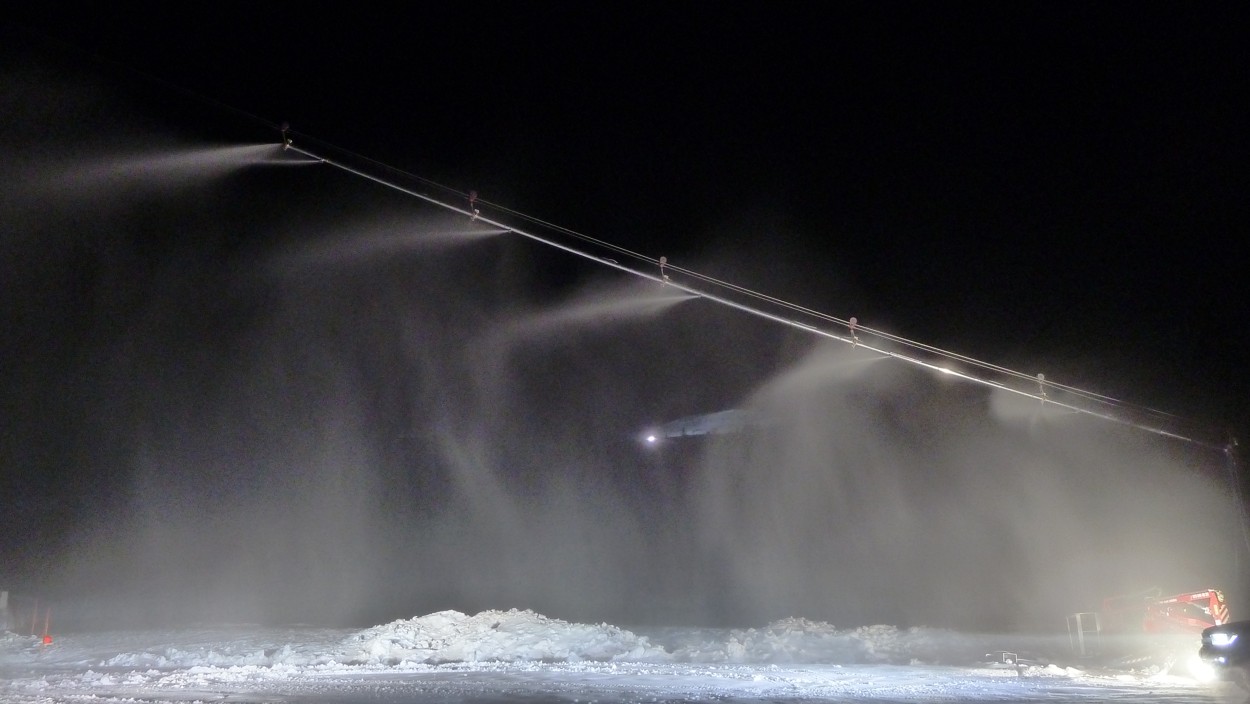
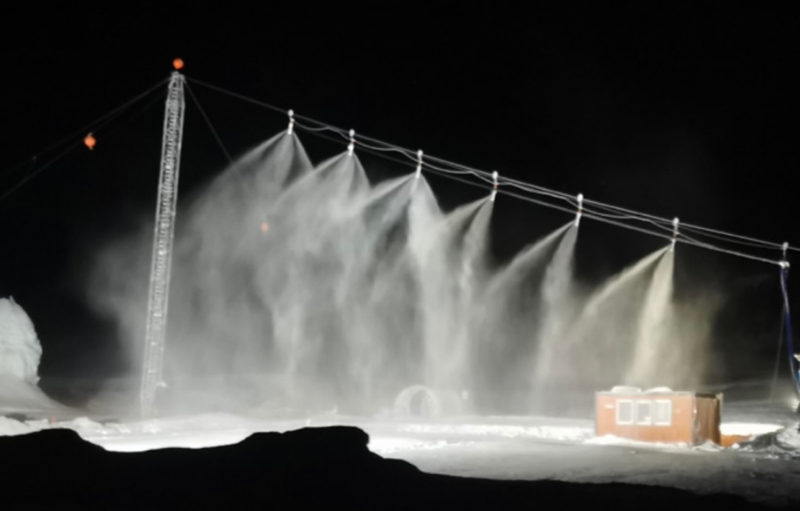
Image 1: Test installation of rope-based snowmaking (ground-independent snowmaking system) during trials in the winters of 2020/21 and 2022/23 (Image: A. Bachmann).
Images 2 & 3: Test installation of snowmaking from cable at the Diavolezza valley station.
Fundamentally, the key innovations of the snowmaking system described above (Figures 1, 2, and 3) lie in its independence from the ground and its significantly increased snowmaking capacity compared to conventional snowmaking systems. It can be operated exclusively with potential energy, i.e., practically without electricity. These three factors must be fulfilled simultaneously in order to effectively curb ice melt on a glacier and thus preserve a frozen landscape for future generations.
Preserving freshwater reservoirs or securing the existence of a ski resort. Given the highly dynamic nature of the climate changes currently taking place, there are even more possible applications:
- (1) Snowmaking on ski slopes in slow-moving permafrost: In conventional snowmaking systems for ski slopes, the connecting pipes between the water reservoir and the snow guns are laid almost exclusively in the ground. This can be very problematic in creeping permafrost and lead to massive additional costs with regular renovation work. In such situations, snow ropes are an attractive alternative.
- (2) Need for a lot of snow in a short period of time: Given the decreasing time windows for snowmaking, these systems, which can produce large amounts of snow in a very short time without major installation costs, could become more important in the future. They are particularly interesting for critical sections of slopes, half pipes, or cross-country trails, especially when snow production competes with the use of the terrain.
Before such a project can be implemented, the natural conditions must be carefully examined when planning a ground-independent snowmaking system.
Two new tools were developed for this purpose, namely COSIPY ArtSnowand the simulation tool SnowCableSim.
First, COSIPY ArtSnow is used to calculate a reference mass balance for the glacier in question and the surrounding glaciers. This is calibrated using measured meteorological data, ablation measurements, and any existing glaciological studies, and its sensitivity to climate change is tested. This mass balance can be used to determine the runoff of the entire glacier (meltwater) or a specific catchment area. The water volume is then used as an input parameter for snowmaking in the SnowCableSim tool.
The tool Snow CableSim on the other hand, focuses on the dimensioning of the snowmaking system, takes into account all technical parameters of snowmaking, and models a mass balance including snow depth and snow distribution on the area intended for snowmaking based on the COSIPY ArtSnow results.
The two tools presented here are not sufficient for determining a favorable location and dimensioning a snowmaking system. The structural engineering conditions must also be clarified, with particular attention being paid to permafrost occurrences and natural hazards.
The Matlab program SnowCableSim was developed to simulate artificial snowmaking on specific sections of glaciers using snow cables. The simulation results can be used to dimension a snowmaking system. If necessary, a reservoir lake can also be simulated to supply the water required for snowmaking. The meltwater flowing into the lake is calculated using the COSIPYArtSnow model.
Are you interested in this project and would like to support it? Here you can make an important contribution with your donation.
 English
  German