
Glacier length fluctuations
Glacier length fluctuations
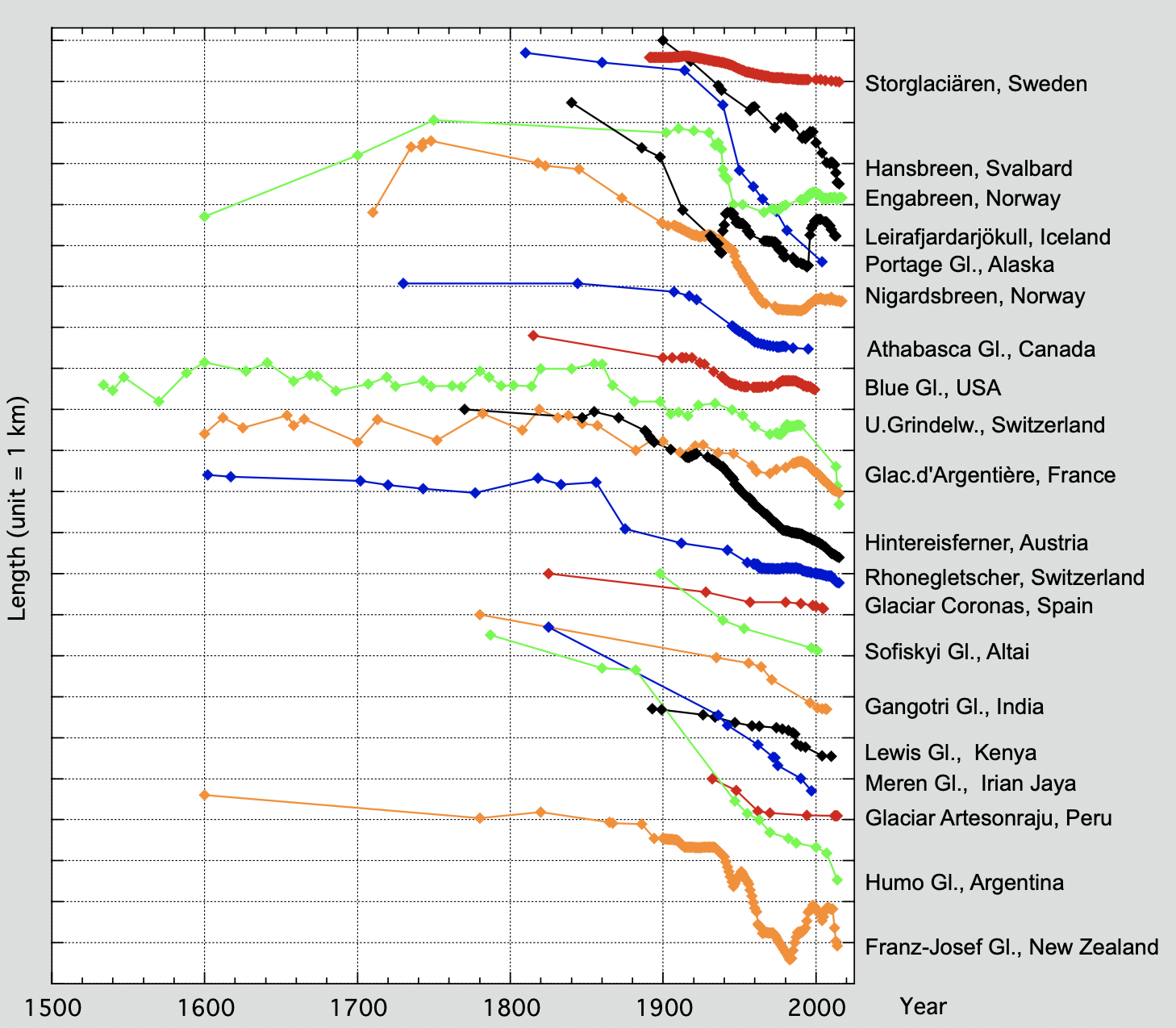
Numerous glacier length records show that on all continents glaciers are retreating (Figure 1, based on Leclerq et al, 2014). Researchers have reconstructed glacier length from old drawings and paintings, moraines, historical maps and, from about 1900 onwards, geodetic measurements. In recent decades, satellite observations have proven to be very helpful in updating records. Glaciers differ in characteristics: many are located in wet climates, others survive in cold and arid conditions. A large percentage of glaciers at higher latitudes are calving glaciers, delivering icebergs to a lake or a fjord. It is thus not surprising that the response of a glacier to climate change differs from glacier to glacier. Nevertheless, the glacier length records in Figure 1 show a large coherence over the globe: in the middle of the 19th century many glaciers started to retreat and have done so until today. The sample shown contains large tidewater glaciers (e.g. Hansbreen, Portage Glacier), typical mid-latitude valley glaciers (e.g. Rhonegletscher, Hintereisferner, Gangotri Glacier), and tropical glaciers (Meren Glacier - disappeared; Lewis Glacier). In some cases short periods of advance have been observed (notably Franz-Josef Glacier; Leirafjardarjökull, surge), but these are minor fluctuations superposed on a clear long-term trend.
In recent decades glacier retreat has accelerated and the volume loss of ice now takes place at an unprecedented rate (Zemp et al. 2015). There is little doubt that the rise in atmospheric temperature is the main cause for the observed glacier decline (Leclerc et al, 2012; Roe, 2011). As has been pointed out in many studies (e.g. Oerlemans et al., 1998; Mernild et al, 2013), most glaciers are strongly out of balance with the current climate, and will therefore continue to retreat for decades to come, even if global warming would slow down.
References
Leclercq PW and Oerlemans J (2012) Global and hemispheric temperature reconstruction from glacier length fluctuations. Clim. Dyn., 38, 1065-1079 (doi: 10.1007/ s00382-011-1145-7)
Leclerq PW, Oerlemans J, Basagic HJ, Bushueva I, Cook AJ and Le Bris R (2014) A data set of worldwide glacier fluctuations, Cryosphere, 8, 659-672 (doi: 10.5194/tc-8-659-2014)
Mernild SH, Lipscomb WH, Bahr DB, Radić V and Zemp M (2013) Global glacier changes: a revised assessment of committed mass losses and sampling uncertainties. Cryosphere, 7(5), 1565–1577 (doi: 10.5194/tc-7-1565-2013)
Oerlemans J and 10 others (1998) Modelling the response of glaciers to climate warming, Clim. Dyn., 14(4), 267-274
Zemp M and 38 others (2015): Historically unprecedented global glacier decline in the early 21st century, J. Glaciol., 61(228), 754-761 (doi: 10.3189/2015JoG15J017)
 English
  German