
How does a glacier work?
How does a glacier work?
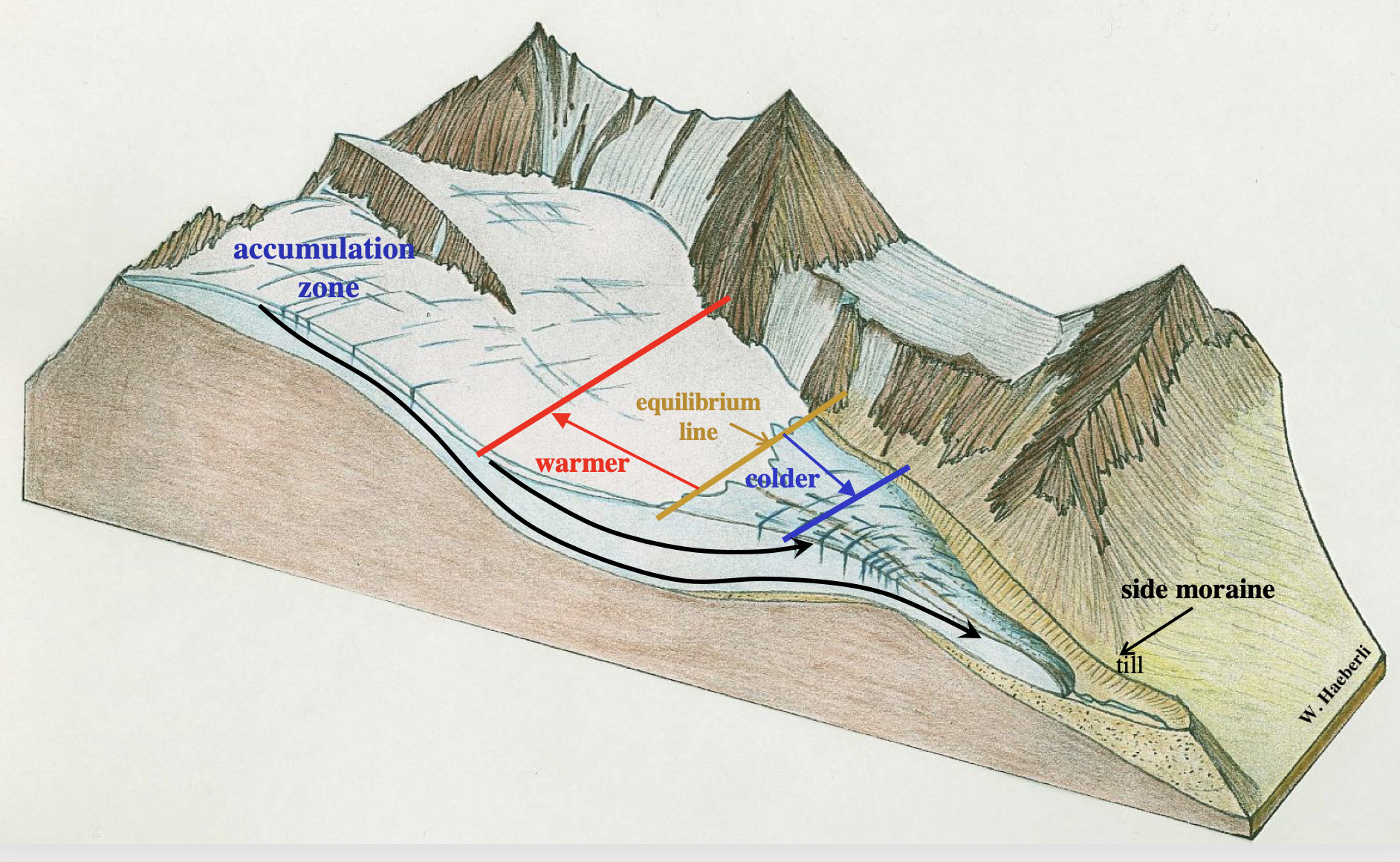
Glaciers form when elevated terrain, a plateau or mountain peaks, is above the so-called equilibrium line. The equilibrium line (yellow in the figure) separates the accumulation zone, where the amount of snowfall in winter exceeds melt in summer, from the ablation zone, where all winter snow disappears in summer. Due to thermodynamic and pressure effects, the snow in the accumulation zone turns into ice. When pressure is high, ice behaves as a viscous material and starts to flow down (black lines). For a glacier in equilibrium with the prevailing climate, the total mass gained in the accumulation zone is equal to the mass lost in the ablation zone. The flow of ice takes care of the necessary mass transfer down-glacier.
When climate warms the equilibrium line will go up, typically by 100 m per degree K temperature increase (e.g. Oerlemans, 2010). There will be more melt and a smaller portion of the precipitation will fall as snow. The ablation zone expands and the accumulation zone shrinks. The net mass budget thus becomes negative. Mass equilibrium can only be restored when the ablation zone is reduced by retreat of the glacier snout. For a cooling climate the opposite takes place and the glacier will expand. Note that for a glacier with a small surface slope the effect of a rising equilibrium line will be larger - such a glacier is more sensitive to climate change.
Most glaciers are currently out of balance with the prevailing climate, i.e. they are 'too large' for the present-day temperatures. At the end of the summer, the size of the accumulation area can be observed by visual inspection. In recent years, in the Alps many smaller glaciers had no accumulation zones anymore because of a very high equilibrium line. Depending on their size, these glaciers will disappear within a few decades (e.g. Zekollari et al., 2019)
Abbildung: W. Haeberli
References
Oerlemans J (2010): The Microclimate of Valley Glaciers. Igitur, Utrecht University, 138 pp. ISBN 987-90-393-5303-5
Zekollari H, Huss M and Farinotti D (2019) Modelling the future evolution of glaciers in the European Alps under the EURO-CORDEX RCM ensemble, Cryosphere, 13, 1125–1146 (doi.org/10.5194/tc-13-1125-2019)
 English
  German